Carbon and Alloy Steel Machining Overview
Carbon and alloy steel parts are specified by grade, standard, delivery condition and the final properties required by the assembly. DXSCNC reviews machining sequence, workholding, thread form, heat-treatment allowance and inspection access from the drawing. Material comparison names do not authorize substitution.
Carbon Steel Grades
45# is a Chinese medium-carbon steel grade used in the published 10,000-piece threaded component production case. The 45# machining guide and carbon structural steel guide give additional designation context.
45# / 1045 / C45 Material Comparison
45# is commonly compared with AISI 1045 and EN C45, but the applicable composition range, mechanical properties, delivery condition and certificate must be checked for the specific purchase order. The real case records 45# material; it does not claim the batch was certified as 1045 or C45.
Alloy Steel Grades
For strength-focused shafts, the drawing should identify grade, section, stock condition, hardness range and any heat treatment. The alloy steel selection guide covers grade-selection logic, and the 42CrMo material page discusses machining features.
42CrMo / 42CrMo4 / 42CrMoS4
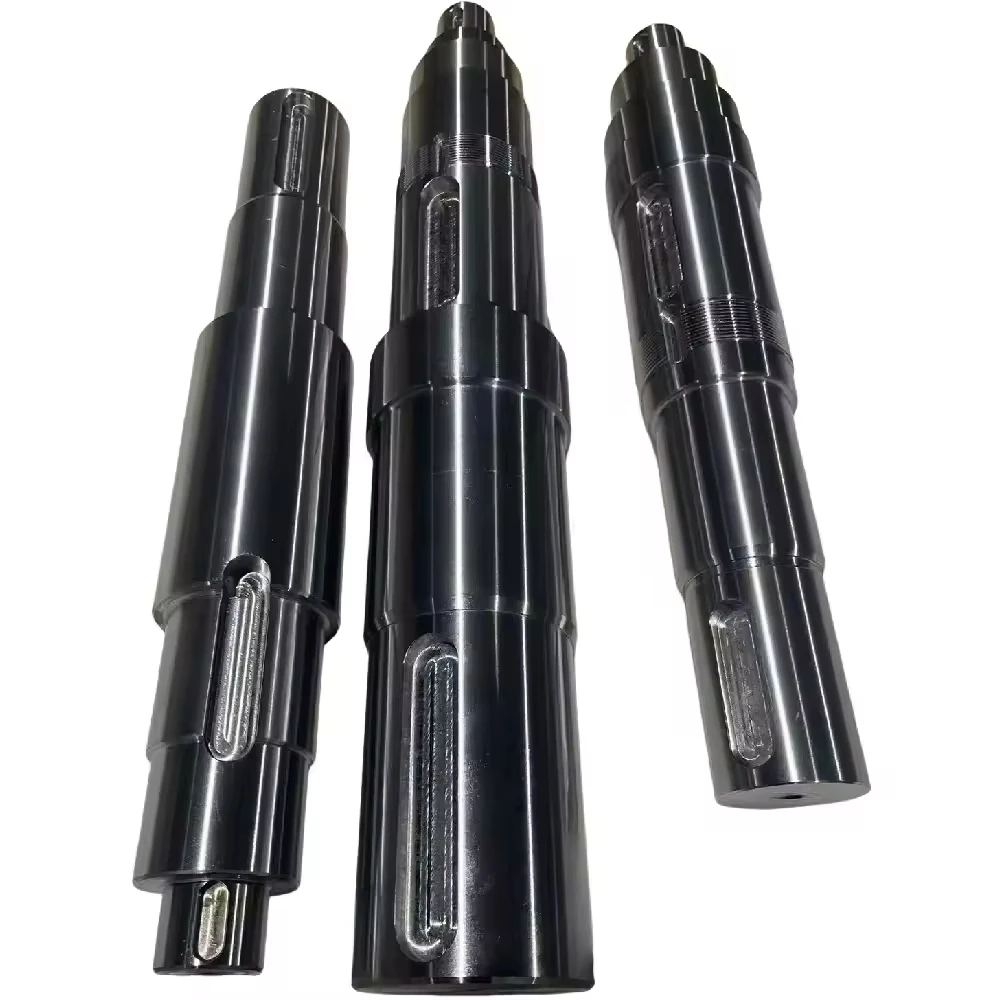
42CrMo is a Chinese designation; 42CrMo4 and 42CrMoS4 are European designations with distinct standards and sulfur-related specification differences. They are comparison or enquiry designations, not unconditional equivalents. The 42CrMo precision shaft series includes real product photographs while avoiding unsupported claims about each photographed part’s exact treatment.
Quenched and Tempered Material Conditions
Specify whether the delivered stock or finished component must be quenched and tempered, and state required hardness and testing stage. The sequence may require rough machining, outsourced heat treatment, allowance for distortion and final machining or grinding. No heat-treatment result is assumed from a black surface appearance.
CNC Turning and Turn-Mill Machining
Turning defines stepped diameters, shoulders, bores and threads. Turn-mill work can add longitudinal slots, flats and radial features in the same process plan where geometry and equipment permit. Datum selection should support both machining and geometric inspection. See DXSCNC capabilities.
Heat Treatment Coordination
Heat treatment is an outsourced process coordinated to the customer drawing. Any hardness, case depth, distortion allowance or post-treatment inspection requirement should be included in the RFQ. It must not be described as an in-house furnace capability.
Cylindrical Grinding
In-house external and internal cylindrical grinding can be evaluated for suitable parts, especially where a post-treatment fit or surface finish requires it. Grinding allowance, datum transfer and final inspection criteria depend on the drawing and process review.
Dimensional and Geometric Inspection
For long shafts and threaded steel parts, important checks may include fit diameters, runout, coaxiality, thread condition and slot location. Inspection method and reporting scope should be agreed before production. See the Quality page for in-house instruments and third-party CMM support.
Related Products and Case Studies
45# threaded production case · 42CrMo shaft series · CNC machined shafts.
Request a Quote
Send your 2D drawing or 3D CAD model with the exact material grade and condition, quantity, critical dimensions, finish and inspection requirements. DXSCNC will review machining feasibility and reply with technical questions where necessary.
Frequently Asked Questions
Is 45# steel certified as AISI 1045 or EN C45 in the published case?
The public case records 45# steel only. A specific equivalence requires review of the applicable standard and material certificate.
Is heat treatment performed in-house?
No. Heat treatment is coordinated externally when required; DXSCNC reviews machining and finishing around that stage.
Explore More DXSCNC Pages
All machining materials · Components · Real manufacturing cases · Capabilities · Quality · Request a quote