Stainless Steel Machining Overview
Stainless steel selection starts with the exact grade and product form on the drawing. DXSCNC reviews turned diameters, bores, radial features, threads, flange faces and inspection access together so the chosen process protects the functional geometry. Corrosion requirements should be stated separately from machining requirements.
Available Stainless Steel Grades
Existing DXSCNC material guidance covers 304 and 316 families. 304L, 316L and 316Ti can be reviewed against the specified standard, stock form and certificate; this page does not imply every variant is held in stock or interchangeable.
Compare stainless steel grade families and review 304 CNC turning.
304 / 304L
304 is relevant to sleeve-type components, shafts, fittings and threaded parts. For a thin sleeve, the bore, outer diameter and radial holes should be related to a clear datum scheme. The existing 304 perforated sleeve product example uses enhanced illustrations, which are labelled as such. 304L must be specified and verified separately when the lower-carbon grade is required.
316 / 316L
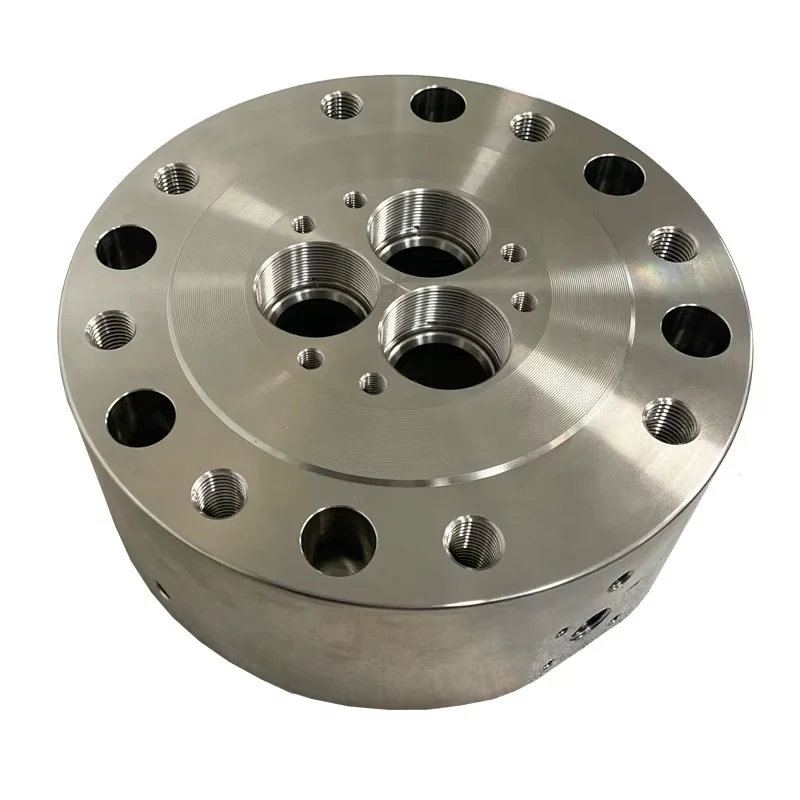
316 and 316L may be selected where the drawing specifies corrosion-related or material-condition requirements. The published 316L multi-port flange shows real DXSCNC product photographs. Its axial and radial threaded ports, bolt-circle features and mating faces require a planned machining and inspection sequence. Do not substitute 316 for 316L without buyer approval.
316Ti and Other Grades
316Ti and other stainless designations are material enquiry options, not documented production claims on this page. Confirm the applicable EN/ASTM/GB designation, certificate, delivery condition and whether the specified grade is essential to the application before quotation.
CNC Turning and Turn-Mill Applications
Turning establishes cylindrical surfaces and bores; turn-mill work adds flats, radial holes, slots and port features where the machine configuration and workholding support them. Threaded stainless parts need thread-form, engagement and burr review. See threaded components and turn-mill capabilities.
Work Hardening and Cutting Heat
Austenitic stainless can harden locally when a tool rubs instead of cutting. Tool condition, engagement, coolant strategy and a stable clamping reference should be selected for the actual feature and batch. Heat concentration at thin walls can also change local dimensions, so feasibility must be checked against the drawing.
Thread Machining and Burr Control
Internal threads and intersecting ports need access for deburring and verification. A burr left inside a cross-hole may affect assembly or flow even when exterior dimensions meet the drawing. Define the thread standard, depth, entry condition and inspection method in the RFQ.
Surface Finishing and Inspection
Specify any passivation, polishing or other surface treatment separately; externally coordinated treatment must not be confused with in-house machining. DXSCNC plans dimensional and visual checks for bores, mating faces, thread fit and critical feature relationships. Third-party CMM reports can be coordinated on request, as explained on the Quality page.
Related Products and Case Studies
316L multi-port flanged component · 304 sleeve illustration · stainless threaded sleeve case study · 316 material page.
Request a Quote
Send your 2D drawing or 3D CAD model with the exact material grade and condition, quantity, critical dimensions, finish and inspection requirements. DXSCNC will review machining feasibility and reply with technical questions where necessary.
Frequently Asked Questions
Can 304 and 316L be substituted for one another?
No. The specified grade, standard, corrosion requirements and material certificate must be reviewed before any substitution.
Can DXSCNC quote a stainless steel part with radial ports?
Yes, subject to drawing review of geometry, material, thread specification, burr access and inspection requirements.
Explore More DXSCNC Pages
All machining materials · Components · Real manufacturing cases · Capabilities · Quality · Request a quote