Common Aluminum Alloys: Series, Grades, Properties, and Applications
Aluminum is widely used in industrial components because it is lightweight, corrosion resistant, easy to form, and suitable for many machining and surface finishing processes. However, different aluminum grades behave very differently in strength, weldability, corrosion resistance, extrusion performance, and CNC machinability.
This guide explains the most common aluminum alloy families, typical grades, and practical selection points for engineering, procurement, CNC machining, sheet metal, profiles, and cast aluminum parts.
Chinese Standards Commonly Used for Aluminum Materials
| Standard | Scope | Practical Use |
|---|---|---|
| GB/T 3190-2020 | Chemical composition of wrought aluminum and aluminum alloys | Used for wrought products such as plate, strip, foil, tube, bar, profile, wire, forgings, and related ingots or billets. Common grades include 1060, 3003, 5052, 6061, 6063, 7075, and 2A12. |
| GB/T 6892-2023 | Extruded aluminum and aluminum alloy profiles for general industrial use | Used for industrial aluminum profiles such as equipment frames, machine frames, guide rails, heat sinks, and mechanical structural profiles. |
| GB/T 5237.1-2017 | Wrought aluminum alloy extruded profiles for architecture - Part 1: Mill finish profiles | Used for architectural aluminum profiles such as doors, windows, curtain walls, guardrails, and architectural decoration profiles. |
| GB/T 1173-2013 | Casting aluminum alloys | Used for cast aluminum alloys such as ZL101, ZL102, and ZL104. |
| GB/T 15115-2024 | Die casting aluminum alloys | Used for die-cast aluminum alloy systems, such as automotive motor housings and electronic control housings. |
Common Alloying Elements in Aluminum
| Element | Name | Main Function |
|---|---|---|
| Al | Aluminum | Base element with low density, good corrosion resistance, good thermal conductivity, and acceptable electrical conductivity. Pure aluminum has low strength and is mainly used for conductive, thermal, and forming applications. |
| Mg | Magnesium | Common in 5xxx and 6xxx alloys. It improves strength and corrosion resistance and generally supports good weldability. |
| Si | Silicon | Common in 6xxx alloys and cast aluminum alloys. It improves casting fluidity and forms strengthening phases with Mg in heat-treatable 6xxx alloys. |
| Cu | Copper | Common in 2xxx alloys. It significantly increases strength but usually reduces corrosion resistance and weldability. |
| Zn | Zinc | Common in 7xxx alloys. Together with Mg and Cu, it can deliver very high strength, but corrosion resistance, weldability, and stress corrosion should be evaluated carefully. |
| Mn | Manganese | Common in 3xxx alloys and also used in some 5xxx and 6xxx alloys. It improves strength and corrosion stability. |
| Fe | Iron | Usually controlled as an impurity element. Excessive Fe can reduce ductility and forming performance. |
The 9 Series of Wrought Aluminum Alloys
| Series | Alloy Family | Typical Grades | Main Characteristics |
|---|---|---|---|
| 1xxx | Commercially pure aluminum | 1060 | Good electrical and thermal conductivity, high ductility, good corrosion resistance, low strength. |
| 2xxx | Aluminum-copper alloys | 2A12, 2024 | High strength and good fatigue performance, but limited corrosion resistance and weldability. |
| 3xxx | Aluminum-manganese alloys | 3003, 3A21 | Good corrosion resistance and formability, stronger than pure aluminum. |
| 4xxx | Aluminum-silicon alloys | 4043 | Often used for welding wire, brazing material, and related applications. |
| 5xxx | Aluminum-magnesium alloys | 5052, 5083 | Good corrosion resistance and weldability, suitable for sheet metal, marine, and welded structures. |
| 6xxx | Aluminum-magnesium-silicon alloys | 6061, 6063, 6082 | Heat treatable with balanced extrusion performance, corrosion resistance, and machinability. |
| 7xxx | Aluminum-zinc alloys | 7075, 7A04 | Very high strength, but poorer weldability and corrosion resistance than many 6xxx alloys. |
| 8xxx | Other alloying element series | Special-purpose grades | Common in aluminum foil, battery foil, packaging, and special applications. |
| 9xxx | Reserved series | - | Rarely encountered in general engineering material selection. |
Common Wrought Aluminum Alloy Grades
1060: Industrial pure aluminum
- Main composition: Aluminum content and impurity control
- Key properties: Excellent electrical conductivity, thermal conductivity, ductility, and corrosion resistance; low strength.
- Common applications: Electrical parts, heat sinks, nameplates, decorative panels, stamped parts.
- Selection note: Use when conductivity, heat transfer, and formability are more important than structural strength.
3003: Al-Mn alloy
- Main composition: Mn
- Key properties: Good corrosion resistance and formability; higher strength than pure aluminum.
- Common applications: Containers, tubing, heat sinks, sheet metal parts, kitchenware, general corrosion-resistant structures.
- Selection note: A practical choice when 1060 is not strong enough but good forming and corrosion resistance are still required.
5052: Al-Mg alloy / rust-resistant aluminum
- Main composition: Mg
- Key properties: Good corrosion resistance, weldability, and formability; stronger than 1060 and 3003.
- Common applications: Sheet metal, enclosures, marine parts, vehicle parts, fuel tanks, stamped parts.
- Selection note: Common for sheet metal, welding, and corrosion-resistant applications.
5083: Al-Mg alloy
- Main composition: Mg, Mn, Cr
- Key properties: Higher strength than 5052, good seawater corrosion resistance, good weldability.
- Common applications: Marine structures, offshore engineering, pressure vessels, welded structural parts.
- Selection note: Suitable for marine environments and higher-strength welded structures.
6063: Al-Mg-Si alloy
- Main composition: Mg and Si
- Key properties: Excellent extrusion performance and surface finishing quality; lower strength than 6061.
- Common applications: Architectural profiles, door and window profiles, decorative profiles, heat sinks, appearance parts.
- Selection note: Often selected for extrusion, anodizing, and visual appearance.
6061: Al-Mg-Si alloy
- Main composition: Mg and Si, with attention to Cu and Cr
- Key properties: Stronger than 6063, good machinability, balanced corrosion resistance and weldability.
- Common applications: Frames, fixtures, CNC machined components, structural parts, connecting plates, brackets.
- Selection note: A widely used default grade when strength, availability, machinability, and balanced performance all matter.
6082: Al-Mg-Si alloy
- Main composition: Mg, Si, Mn
- Key properties: Generally stronger than 6061 and commonly used in structural profile applications.
- Common applications: Structural profiles, mechanical structures, vehicle structures, load-bearing aluminum parts.
- Selection note: Use when a 6xxx structural alloy stronger than 6061 is preferred.
2A12: Hard aluminum / older Chinese designation LY12
- Main composition: Cu and Mg
- Key properties: High strength and good fatigue performance, but poor corrosion resistance and limited weldability.
- Common applications: Aerospace structural parts, riveted parts, high-strength plates, loaded components.
- Selection note: Suitable for high strength and fatigue requirements, but corrosion protection and joining method must be considered.
7075: High-strength aluminum alloy
- Main composition: Zn, Mg, Cu
- Key properties: Very high strength and good machinability, but poor weldability and lower corrosion resistance than 6xxx alloys.
- Common applications: Aerospace parts, high-strength fixtures, mold plates, high-load lightweight components.
- Selection note: 7075-T6 or 7075-T651 can be used for high-strength lightweight parts, but it should not be treated like ordinary weldable structural aluminum.
7050 Aluminum Alloy CNC Machining: Material Selection, Turn-Mill Planning and Inspection
7050 is a heat-treatable, high-strength wrought aluminum alloy in the 7xxx family. Zinc is its principal alloying element; magnesium and copper also contribute, and zirconium is part of its registered composition. For a CNC drawing, “7050” alone is an incomplete instruction: the product form, governing specification, temper, dimensions, required properties and finishing must be identified before a machining route is agreed.
Key takeaways
- State the alloy, product form, temper and specification on the drawing.
- Do not transfer 7075 data to 7050, or data from one temper to another.
- Check critical dimensions after the operations most likely to release stress.
- Agree with the finishing supplier how anodizing affects dimensions and appearance.
How does 7050 differ from 7075?
Both alloys belong to the high-strength aluminum-zinc family, but their registered compositions differ. Their strength and resistance to stress-corrosion cracking cannot be ranked by name alone: temper, product form, thickness and test direction all matter. Producer data list 7050 plate in T7451 and T7651 conditions and 7075 plate in T7351, and show that 7075 in T651 and T7351 has a different strength and stress-corrosion balance. A 7075-T6/T651 result must therefore not be applied to 7050-T7451, and a corrosion claim for an overaged temper must not be applied to all 7xxx stock. Always review the customer's governing specification and the mill certificate of the actual stock.
| What the drawing should specify | Why it matters |
|---|---|
| Alloy designation | 7050 and 7075 are distinct registered alloys. |
| Product form and dimensions | Properties vary with form, thickness and direction. |
| Temper | Strength and stress-corrosion behavior depend on it. |
| Governing standard and edition | Defines acceptance requirements. |
| Finishing requirement | Affects appearance and final dimensions. |
Which parts may suit 7050?
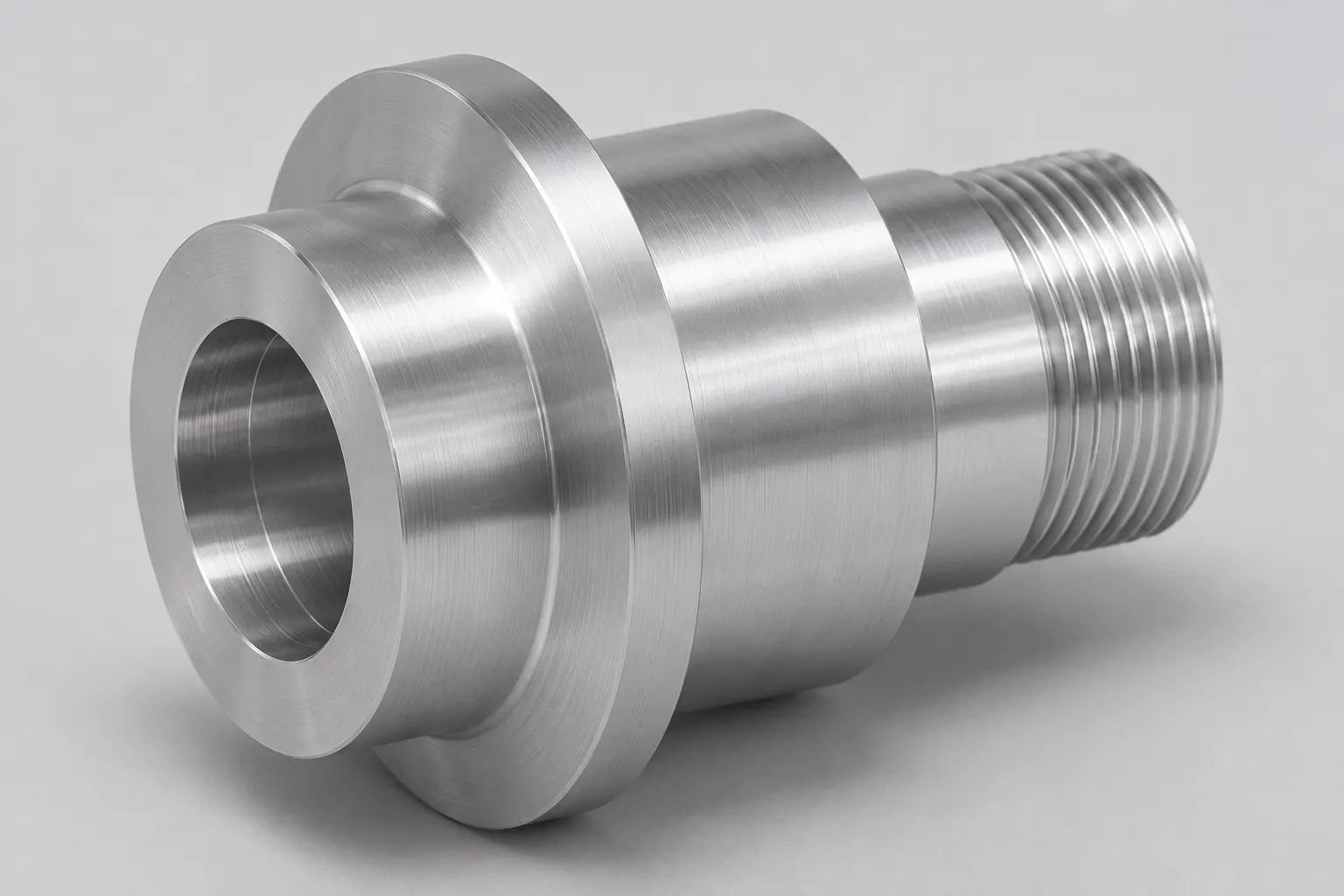
7050 may be considered for lightweight, high-load rotational components where the drawing calls for a high-strength alloy and the stock form is available: shafts, stepped sleeves, bushings, flanges, threaded bodies, and cylindrical parts with cross holes, flats, windows or slots. These are design examples, not claims that a particular DXSCNC part was made in 7050.
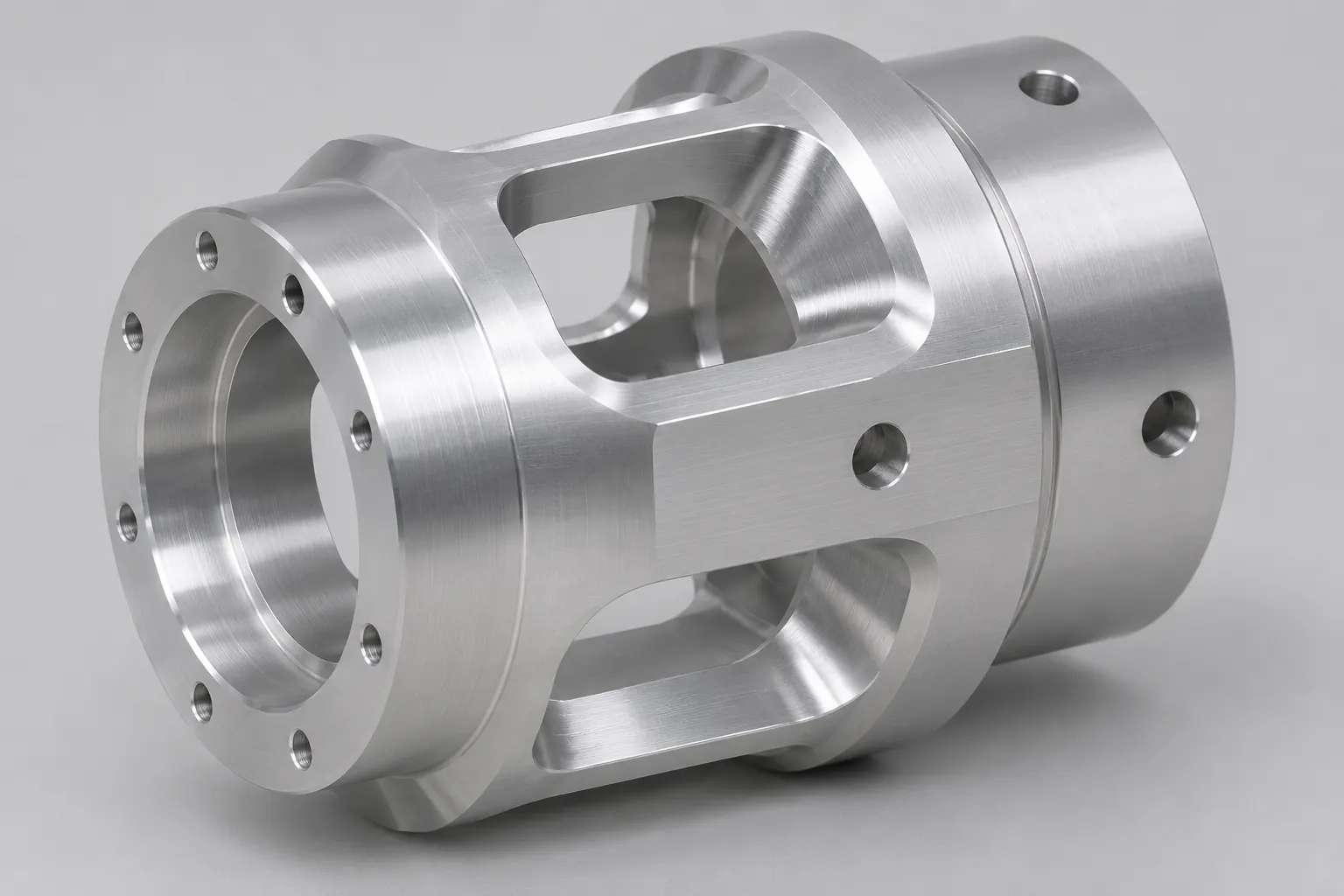
The existing 7075/7050 turn-mill component page shows a real 7075 black-anodized part. It illustrates relevant geometry and process, but it is not a 7050 production photograph or case study.
How should turning and four-axis turn-mill work be planned?
Start with the material condition and the finished datum scheme. In CNC turning, plan the OD, bores, shoulders and threads around stable workholding and the drawing's functional references. For long or thin-wall features, control clamping force and allow for deflection. For deep bores and cross drilling, review chip evacuation, tool access and burrs at intersections.
When flats, radial holes, slots or windows are required, four-axis turn-mill machining can keep a common setup where feasible, but feature position and runout still need drawing-specific verification. A route may combine roughing, intermediate checks and finishing to manage material removal and residual-stress movement. The actual sequence depends on stock form, temper and geometry.
Why does temper affect dimensional stability?
Heat treatment and stress-relief history influence mechanical properties and residual stress. Aerospace plate suppliers treat low distortion and lot-to-lot consistency as properties of specific products, not as universal guarantees for the alloy. Heavy asymmetric removal, thin walls and long overhangs can show movement after roughing or unclamping. Specify the temper and stock condition, leave a suitable finishing allowance where the drawing requires it, and re-check critical dimensions after the operations most likely to release stress. No single hardness or tensile value applies to all 7050 tempers.
Can 7050 be black anodized?
It can be evaluated, but the result must be qualified with the finishing supplier for the actual alloy, temper and surface condition. Alloy chemistry and surface preparation affect appearance, and coating and pretreatment can alter final dimensions. State the anodizing specification, color target or approved sample, masking requirements, and whether bores, threads or mating faces are measured before or after finishing. A black-anodized 7075 sample does not prove that 7050 will match its shade or texture.
What should be inspected?
Define acceptance dimensions on the drawing: critical ODs and bores, thread fit, shoulder position, feature location, runout where specified, surface roughness and visual requirements. Agree which features are inspected after anodizing and how the coating is accounted for. DXSCNC performs dimensional inspection with its confirmed in-house methods and can arrange CMM inspection through a third-party metrology provider when the drawing requires it. Tolerances and finishes for a new 7050 part are evaluated from the specific drawing and process plan.
Request a quote
Send the 2D drawing and/or 3D model, material standard, 7050 temper and stock form, quantity, critical dimensions, thread and surface requirements, anodizing specification and intended application through the RFQ page. DXSCNC can review the proposed turning or turn-mill route, finishing coordination and inspection plan before quoting.
Technical sources
- Aluminum Association Teal Sheets: registered alloy designations and compositions.
- Aluminum Association standards overview: 7xxx family description.
- ASTM B209: sheet and plate specification framework; use the applicable edition for a purchase order.
- Kaiser 7050 tube and pipe data: product- and temper-specific characteristics.
- Kaiser 7075 sheet and plate data: T651 and T7351 comparison.
- KaiserSelect aerospace plate: listed 7050 and 7075 plate conditions.
- Aluminum Anodizers Council alloy and temper guidance and anodizing FAQ: appearance and dimensional considerations.
Aluminum Profiles
Industrial aluminum profiles, such as equipment frames, machine frames, guide rails, heat sinks, and mechanical structural profiles, are typically covered by GB/T 6892-2023.
Architectural aluminum profiles, such as doors, windows, curtain walls, guardrails, and decorative profiles, are usually covered by the GB/T 5237 series. GB/T 5237.1-2017 is the mill-finish base material part.
Common profile grades are mainly concentrated in the 6xxx series, including 6063, 6061, 6005, 6005A, and 6082. In general, 6063 is preferred for extrusion, appearance, and surface treatment, while 6061 and 6082 are preferred when structural strength is more important.
Cast Aluminum Alloys: ZL Series
Wrought aluminum alloys and cast aluminum alloys are different material systems. Grades such as 1060, 5052, 6061, and 7075 belong to wrought aluminum alloy families. In Chinese standards, common cast aluminum alloys are often identified by ZL grades.
ZL101: Cast Al-Si-Mg alloy
- Main composition: Si and Mg
- Key properties: Good casting performance, heat treatable, good strength and corrosion resistance.
- Common applications: Aluminum castings, pump bodies, motor housings, brackets, box-type parts.
- Selection note: Suitable for sand casting, metal mold casting, and general cast aluminum components.
ZL102: Cast Al-Si alloy
- Main composition: Si
- Key properties: Good fluidity and casting performance, but relatively low strength.
- Common applications: Thin-wall castings, complex-shape castings, general housings.
- Selection note: Useful when casting fluidity and complex forming are more important than high strength.
ZL104: Cast Al-Si-Mg alloy
- Main composition: Si and Mg
- Key properties: Good overall performance and suitable for castings with higher mechanical requirements.
- Common applications: Housings, brackets, pump bodies, mechanical castings.
- Selection note: More load-capable than ordinary Al-Si casting alloys.
Note on Die-Cast Aluminum
Die-cast aluminum alloys are not the same as wrought aluminum or ordinary sand-cast aluminum alloys. Automotive motor housings, electronic control housings, and many high-volume die-cast components may use a die-casting alloy system such as GB/T 15115-2024.
Quick Selection Summary
| Requirement | Common Material Options |
|---|---|
| Need electrical conductivity, thermal conductivity, and easy forming | 1060 |
| General sheet metal, containers, and corrosion resistance | 3003, 5052 |
| Marine, offshore, and welded structures | 5083 |
| Extrusions, window/door profiles, heat sinks, and appearance parts | 6063 |
| CNC machining, fixtures, frames, and general structural parts | 6061 |
| Higher-strength 6xxx structural parts | 6082 |
| High-strength plates and aerospace riveted parts | 2A12 |
| High-strength lightweight machined parts | 7075 |
| Cast aluminum components | ZL101, ZL102, ZL104 |
CNC Machining Notes for Aluminum Parts
- 6061 and 6082 are often practical choices for CNC machined aluminum parts because they combine availability, machinability, strength, and stable surface treatment performance.
- 7075 is suitable for high-strength lightweight components, but corrosion protection, stress concentration, and joining methods should be reviewed carefully.
- 5052 is more common in sheet metal and welded components than in precision CNC machined structural parts.
- For aluminum profiles, grade selection is often driven by extrusion performance, surface finish, and structural strength requirements rather than machining alone.
- For cast aluminum parts, machining allowance, casting porosity, heat treatment state, and datum control should be confirmed before CNC finishing.
Need CNC Machined Aluminum Components?
For aluminum CNC turned parts, turn-mill components, shafts, sleeves, bushings, flanges, threaded adapters, and precision spacers, DXSCNC can help review the drawing, material selection, tolerance risk, surface finish, and manufacturing route before production.
Use the model-specific machining limits when planning a part. Material, geometry, tolerance, workholding and inspection affect machine selection.
Related DXSCNC resources: 6061 Aluminum CNC Machining, 6082 Aluminum CNC Machining, 7075 Aluminum CNC Machining, CNC Turning, Turn-Mill Machining, and Quality Inspection.