Brass CNC Machining Overview
Brass is useful for drawing-based turned connectors, threaded sleeves, adapters and fittings. Machinability varies with composition and temper, so a generic “brass” callout is insufficient where strength, conductivity, drinking-water rules or lead content matter. DXSCNC reviews material and finish requirements with the part geometry.
Available Brass Grades
H59, H62, H65 and H68 are distinct Chinese brass grades; CZ121 and C3604 are commonly discussed international machining designations. Similar applications do not make these grades automatically equivalent. Specify the standard edition, chemical composition limits, delivery condition and certification needs. See the copper alloy grade guide.
H59 / H62 / H65 / H68
The copper-to-zinc balance and any additional elements affect cutting, forming, corrosion behavior and compliance. For an RFQ, name the actual grade and stock form rather than selecting from a visual match. If a buyer permits an alternative, the substitution must be approved against required properties and the certificate.
CZ121 / C3604
CZ121 and C3604 may be proposed for suitable turned-part enquiries where the drawing and applicable restrictions allow them. They must not be advertised as exact replacements for H59, H62, H65 or H68. Confirm lead-related requirements and regional regulations with the buyer before material purchase.
Thread Machining
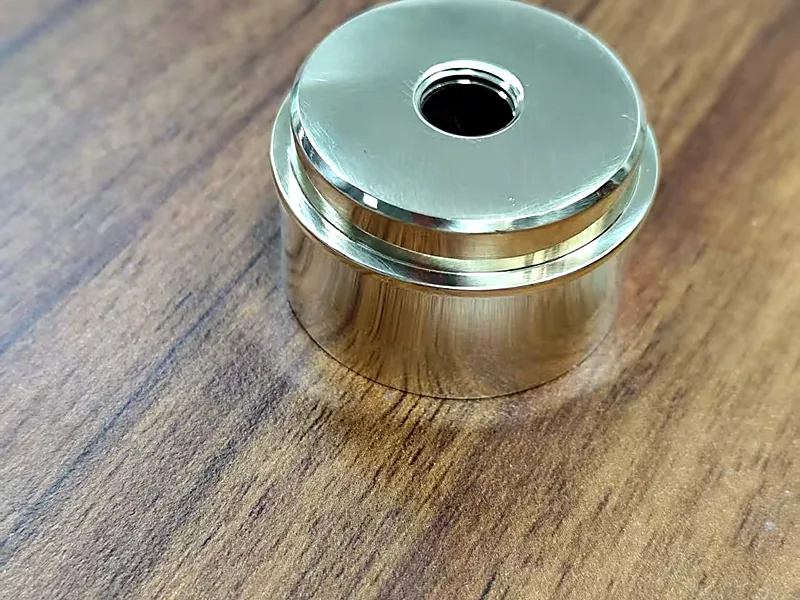
Brass threaded components may combine internal and external threads, shoulders and cross-holes. Thread standard, class, engagement length, entry chamfer and gauge method are more useful to the machinist than a general “precision thread” label. The mirror-polished brass threaded sleeve production example shows a photographed surface and bore/thread detail.
Sealing Face Machining
A sealing face should be dimensioned to the bore or thread datum that controls assembly. State flatness, roughness, finish direction, edge condition and whether a coating applies. A polished appearance alone does not establish a sealing performance or leak-test result.
Cross-Hole and Burr Control
Radial holes, intersecting ports and milled windows create internal burr risk. The drawing should identify inaccessible edges and any cleanliness or flow requirement so tool access and inspection can be planned. See adapters and fittings for related geometries.
Surface Protection and Packaging
Mirror-polished or plated brass can show handling marks even when the dimensions are correct. Define the cosmetic class, surface-treatment provider, separation method and thread protection before shipment. Plating is an externally coordinated process where specified.
Related Brass Products and Cases
brass turned fittings · brass turn-mill inspection case · polished brass sleeve example · machining capabilities · quality and inspection.
Request a Quote
Send your 2D drawing or 3D CAD model with the exact material grade and condition, quantity, critical dimensions, finish and inspection requirements. DXSCNC will review machining feasibility and reply with technical questions where necessary.
Frequently Asked Questions
Are H62 and CZ121 the same material?
No. Grade designations and standards differ. Review composition, properties, compliance and customer approval before substitution.
What should a brass fitting RFQ include?
Provide the drawing, grade and standard, quantity, thread callouts, sealing-face and finish requirements, inspection needs and packing instructions.
Explore More DXSCNC Pages
All machining materials · Components · Real manufacturing cases · Capabilities · Quality · Request a quote